Changing the back crotch curve (rise) of jeans
If there’s one place where a pair of jeans quietly succeeds—or loudly fails—it’s the back crotch curve. You can nail the fabric, the wash, the rise, and the leg shape, but if the back curve is off, the whole garment feels wrong. Drag lines, sagging under the seat, a wedgie effect, or that mysterious horizontal crease that won’t press out all trace back to this one, often-misunderstood line.
Getting the back crotch curve right is equal parts anatomy, geometry, and observation. It’s not about adding “more room” or blindly scooping the curve deeper—it’s about understanding how the body occupies space when it stands, sits, and moves.
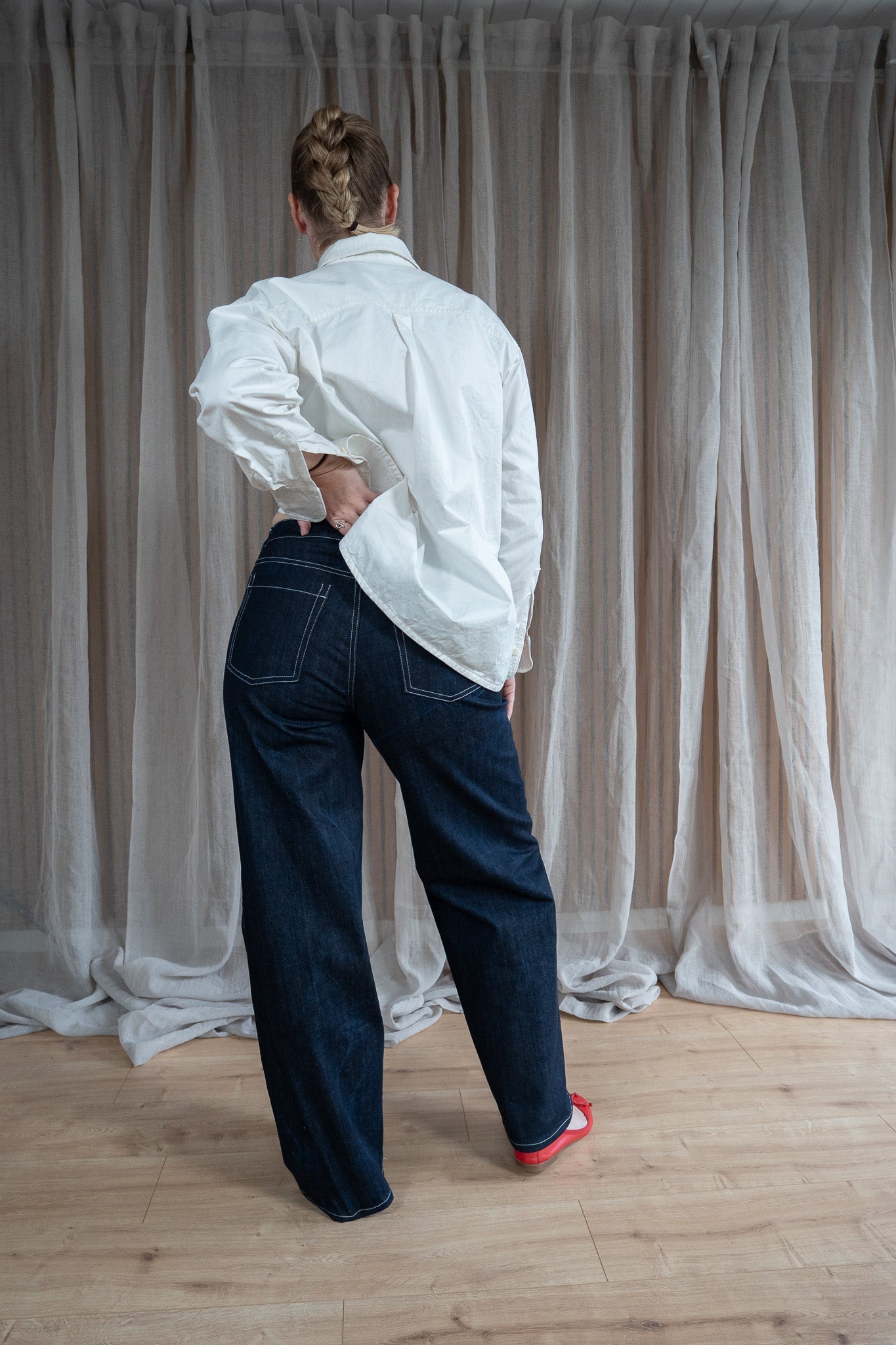
In this blog-post, I'll show you how to change the back crotch curve of the Hassel jeans sewing pattern, so you can transform it from a "mom-fit" pair of jeans to a classic pair of jeans.
You'll be surprised with how small, precise adjustments can completely transform the fit!
Follow the guide below if you - like me - are curious about finding that perfect fit!
Changing the back crotch curve of jeans Hassel

1. Trace the pattern
Trace off the back pattern piece in your size, including all key reference lines such as the grainline, hip line, and high thigh line.
2. Slash and pivot
Slash the pattern from the high thigh line along the side seam over to a point low on the crotch curve. Pivot the upper portion of the pattern to create a wedge that is approximately 1–1.5 cm (3/8"–5/8") deep at the widest point.
3. Adjust the crotch curve
From the lowest point of the wedge, measure 1 cm (3/8") horizontally toward the crotch extension. At the same time, trim off the tip of the original crotch curve—ideally by the same amount that you opened the wedge.
Smooth the adjusted inseam and redraw (“true”) the new crotch curve, making sure it passes through the point you measured 1 cm from the wedge opening.
4. Review the result
This is your adjusted back crotch curve. The green-filled area shows how ease has been transferred from the high thigh area to the lowest part of the back crotch curve—effectively adding more room where the body needs it most: the seat.
Notice that the length of the crotch curve is still the same!
Which back crotch curve is right for you?
There’s no single “correct” back crotch curve. The best shape depends on your unique body features, personal fit preferences, and even current style or fashion trends. To find your ideal back crotch curve, you’ll need to test a few variations and observe how each one behaves on your body.
Furthermore, achieving the perfect back crotch curve always depends on the garment you’re making. In the example above, I’m showing an adjustment specifically for jeans—a close-fitting style that requires a more precise, body-hugging crotch shape.
Regular trousers, slacks, or pants need a slightly different approach. Their back crotch curves will vary depending on the intended silhouette, amount of ease, and overall design of the pattern. A relaxed trouser, for example, distributes ease very differently than a pair of rigid denim jeans.
So sadly (or maybe reassuringly!), there isn’t one single “perfect” crotch curve that works for every type of pant. Fit is contextual—and the best curve is always the one that works for this fabric, this style, and this body.
Fit is feedback—and experimenting is the only way to truly dial it in.

Written by Iben Andersen Revsbech

Leave a comment
This site is protected by hCaptcha and the hCaptcha Privacy Policy and Terms of Service apply.